We built a global paranormal sighting platform with AI credibility scoring, forensic image analysis, and a live map. Here is the full story of how and why.
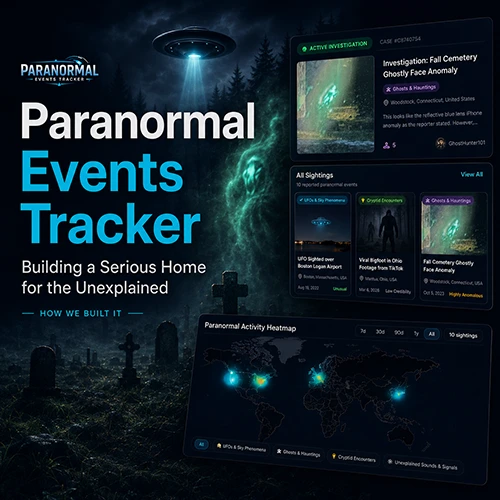
Paranormal Events Tracker is a platform we built to give the unexplained something it has never had: proper infrastructure. A live global map of sightings. AI credibility scoring on every report. A forensic image analysis toolkit that would not be out of place in a crime lab. Community-driven investigations with real case tracking. Social media integration that pulls in viral paranormal content and runs it through the same scrutiny as firsthand reports. We built the whole thing with AI assistance and shipped it as a serious research tool disguised as something you cannot stop clicking around in.
The Problem Nobody Was Solving
People have been reporting strange things for as long as people have existed. Lights in the sky that move against the wind. Shapes in the woods that do not belong to any animal anyone can name. Faces in photographs where no face should be. These experiences are not rare. They are everywhere, all the time, across every country and culture on the planet.
And yet the places people go to share them are terrible.
Scattered forums where posts vanish into threads nobody will ever scroll back to. Reddit comments buried under jokes. TikTok videos with millions of views and zero analysis. Facebook groups where every blurry photo gets the same response: “OMG that’s definitely a ghost!” or “Fake, next.” No structure. No scoring. No way to separate the genuinely strange from the obviously manufactured.
We looked at what existed and saw the same gap we have seen in other spaces before building tools like LivePeeker. There was a real community with a real need, and the tools available to them were not even close to good enough.
So we built something better.
What Paranormal Events Tracker Actually Is
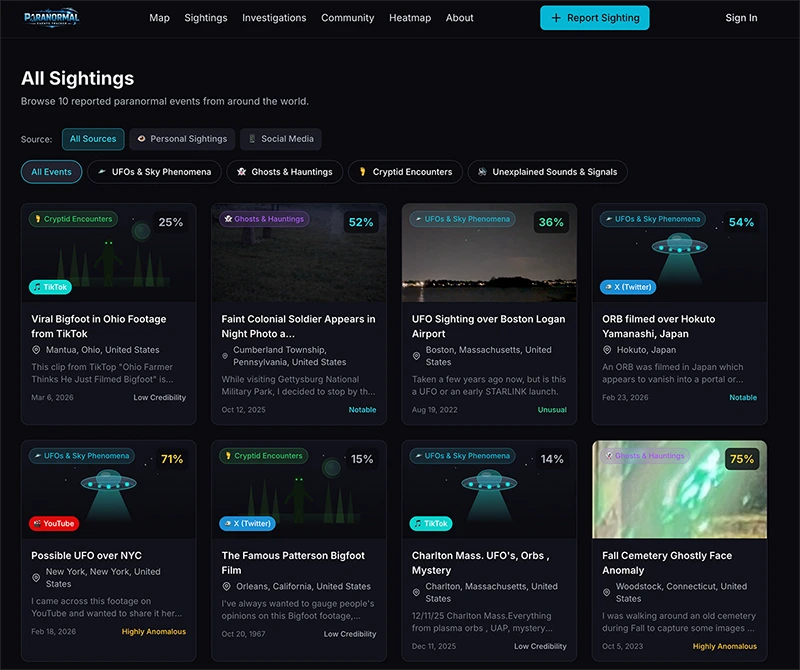
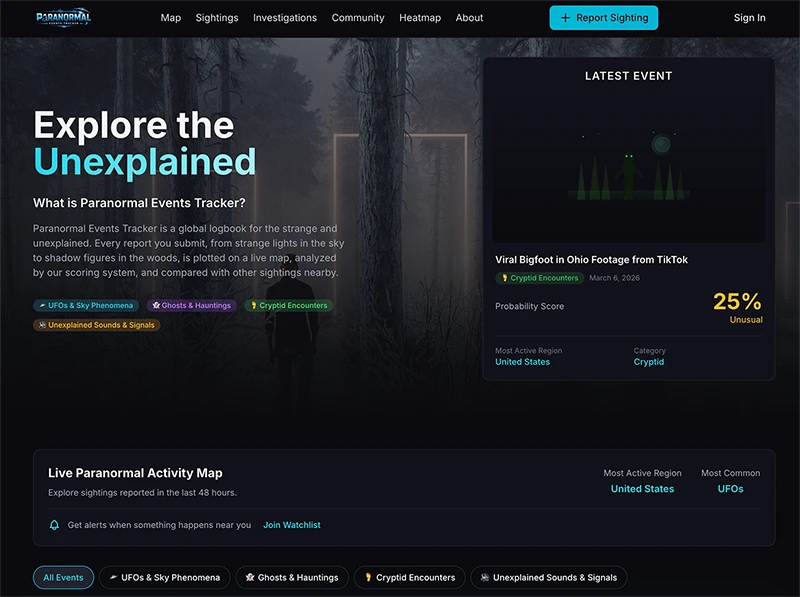
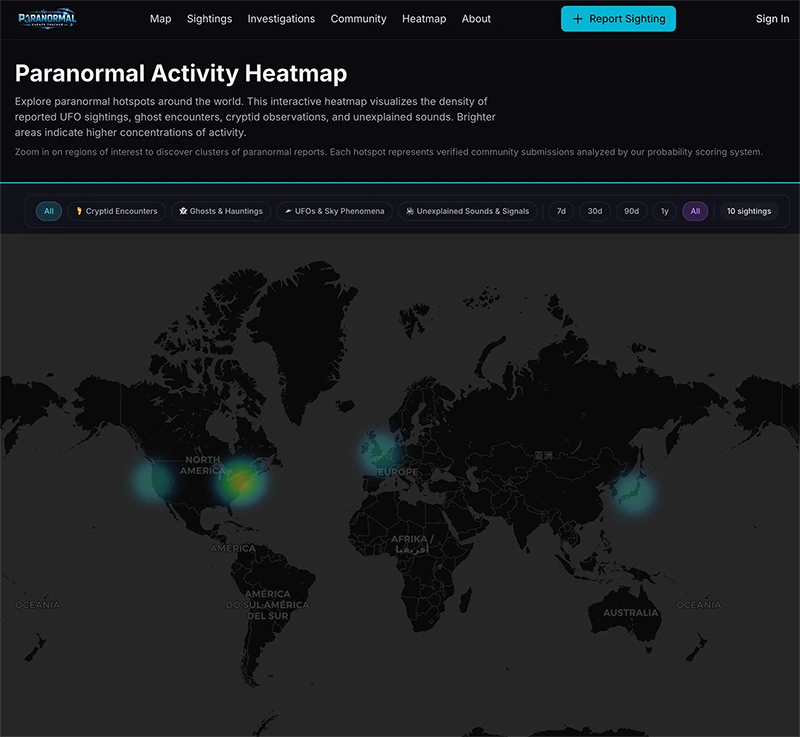
At its core, it is a living global map of the unexplained. Every sighting that gets reported is plotted geographically, so instead of reading isolated accounts scattered across the internet, you can see the bigger picture forming across regions and continents in one place.
A cluster of UFO reports over a particular stretch of coastline. A run of cryptid encounters in a specific national forest. Ghost activity concentrated around a historic town. When you zoom out, patterns that would be invisible in a single report begin to emerge.
Everything is organized into four categories:
- UFOs and Sky Phenomena: unidentified flying objects, strange lights, aerial anomalies
- Ghosts and Hauntings: apparitions, spirits, haunted locations, unexplained presences
- Cryptid Encounters: Bigfoot, lake monsters, creatures science has not catalogued
- Unexplained Sounds and Signals: strange noises, mysterious broadcasts, things that defy easy explanation
The map is not static either. It shows activity as it happens. New sightings appear in something close to real time. Pair that with the watchlist feature, which sends you alerts when something is reported near your location, and it starts to feel less like a database and more like a radar for the paranormal.
The Feature That Changes Everything: AI Credibility Scoring
This is where Paranormal Events Tracker breaks from every ghost forum and UFO message board that came before it. Every single sighting submitted to the platform receives an AI credibility score from 0 to 100 percent.
No more guessing whether a report is worth taking seriously. The system does the initial analytical work for you.
The score is not arbitrary. It weighs several distinct factors:
| Factor | What it measures |
|---|---|
| Description quality | Detailed, specific reports score higher than vague ones. “I saw a light” scores lower than “I observed a stationary orange light at approximately 40 degrees elevation for three minutes before it accelerated northeast.” |
| Evidence | Photos and videos push credibility up. A sighting with visual evidence is always worth more than text alone. |
| Reporter reputation | Established users with a track record of verified reports carry more weight than brand new accounts. |
| Corroboration | When similar sightings are reported nearby, the scores reinforce each other. Independent confirmation matters. |
| Recency | Slight weighting for freshness. A report filed hours after a sighting is more reliable than one filed months later. |
| Source type | Firsthand reports are weighted differently from social media finds. Both are valid. Both are scored honestly. |
The result is that when you browse the sightings feed, you are not looking at an undifferentiated pile of claims. You see a viral Bigfoot clip from Ohio sitting at 25 percent credibility right next to a highly anomalous cemetery photograph scoring 75 percent. The scores tell you where to focus your attention and where something might genuinely be worth a closer look.
Social Media Integration Done Right
Not every strange thing gets witnessed firsthand. A huge amount of paranormal content surfaces on social media first. A farmer films something odd at the treeline and it blows up on TikTok. An orb appears in someone’s footage and spreads across X. Rather than pretending this content does not exist, we brought it directly into the system.
When you submit a sighting, you can indicate that you found it online and paste a link from TikTok, X, Instagram, Facebook, or YouTube. The original post gets embedded right on the sighting page, so visitors can view the source material in its full context rather than relying on a secondhand description. You can credit the original poster too, so the person who first captured the footage gets acknowledged.
These social media sightings go through the same review and scoring process as firsthand reports, but with adjusted weighting that reflects their secondhand nature. Community votes carry extra influence on these entries. You can filter the feed between personal reports and social media finds, so whether you want raw firsthand accounts or the best of what is circulating online, you choose your lens.
The goal was never to keep social media content out. It was to hold it to the same standard as everything else on the platform.
From Sighting to Investigation
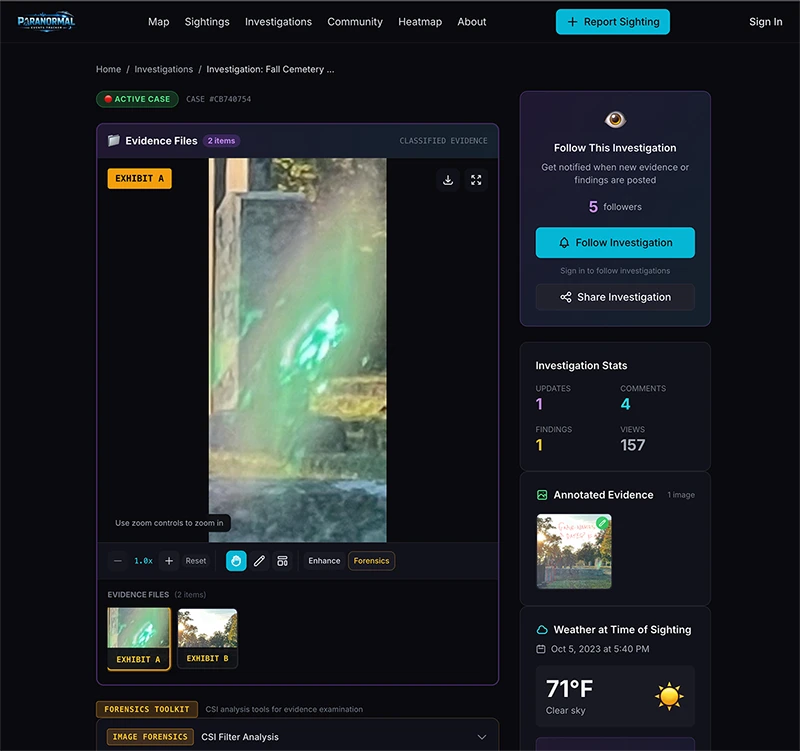
A sighting on a map is a starting point, not an ending. Any sighting can be escalated into a formal community investigation, and this is where the platform transforms from a reporting tool into a collaborative research environment.
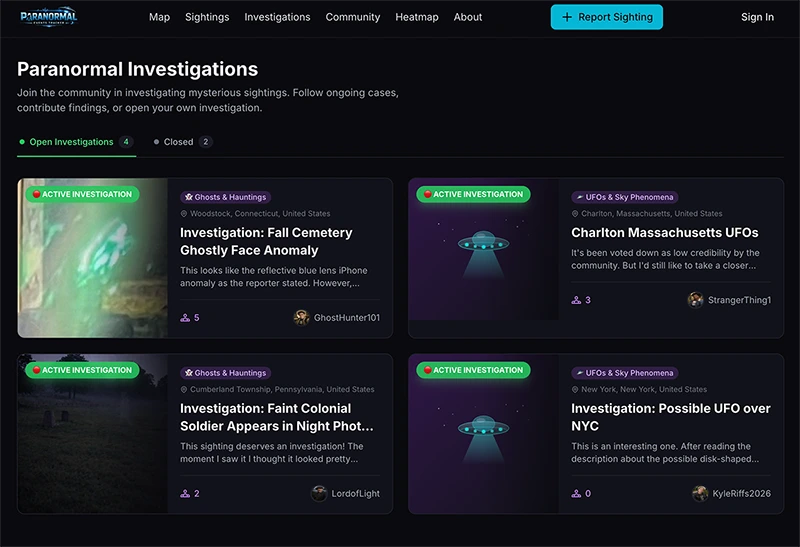
Each investigation becomes its own case with a status of open or closed. Members of the community can follow a case to get notified when new evidence or findings are posted. They can contribute updates, upload evidence, post comments, and work collectively toward a verdict. Every case tracks its own statistics showing the number of updates, comments, findings, and views it has accumulated. Some investigations even capture contextual details like the weather at the time of the sighting, so a report of strange lights can be cross-referenced against whether the sky was clear or overcast that evening.
The active cases at any given moment read like the opening lines of short stories:
- A ghostly face anomaly captured in a Connecticut cemetery during autumn
- UFOs reported over Charlton, Massachusetts
- A faint colonial soldier that appears to materialize in a night photograph taken at a Gettysburg battlefield
- A possible disk-shaped object filmed over New York City
These are not hypotheticals. They are real cases that real people opened, followed, and dug into together.
The Forensics Toolkit
If the AI scoring is the feature that sets Paranormal Events Tracker apart from every other platform, the Forensics Toolkit is the feature that makes serious investigators lean forward in their chairs.
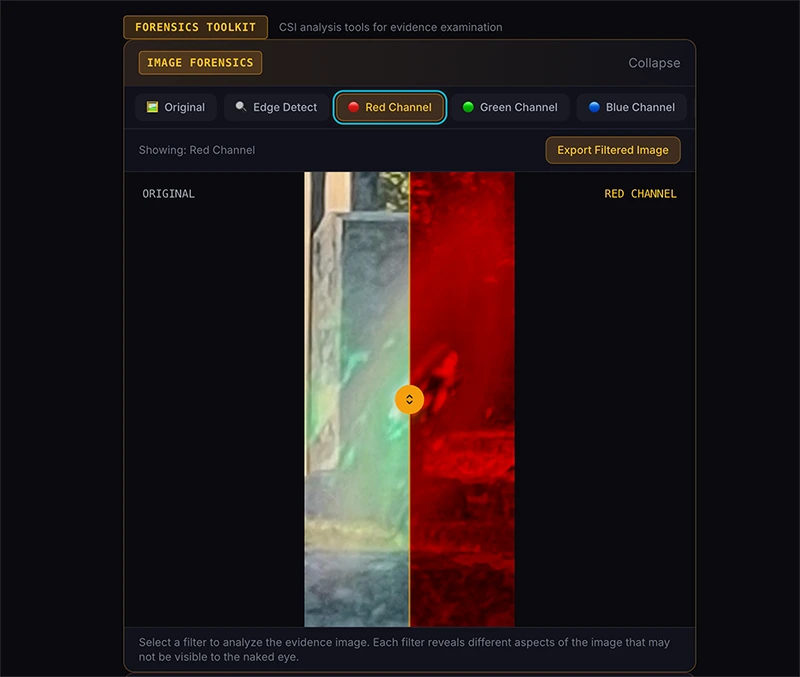
When you open an investigation, you get access to a genuine suite of analysis tools. The kind of thing you would expect from a crime lab, not a paranormal website.
Image Forensics. Nine distinct filters for CSI-style analysis. Edge detection highlights shapes and outlines. A thermal view surfaces heat signatures. Channel isolation lets you view the red, green, and blue channels separately, which can expose composited or manipulated elements that blend into the full-color image. Negative, histogram equalization, sharpen, and emboss filters each reveal details invisible to the naked eye. You can adjust the intensity and export any enhanced image you produce.
Error Level Analysis. A technique borrowed straight from digital forensics. It recompresses an image at a known quality level and highlights the differences, causing edited or composited regions to appear brighter than their original surroundings. A split slider lets you compare the original against the analysis side by side. If someone pasted a ghost into a photograph, ELA is one of the tools most likely to catch it.
Size Analysis. Estimate the real-world dimensions of an unknown object. You mark a reference object of known size, like a person or a car, enter its actual measurement, then mark the mystery object to get a calculated estimate. Suddenly a debate about whether that shape in the woods is seven feet tall or three feet tall becomes something you can measure rather than argue about.
This toolkit turns armchair speculation into something closer to methodical analysis. It gives the community the means to debunk the fakes and, just as importantly, to identify the sightings that hold up under scrutiny.
How We Built It
Same approach we used for LivePeeker and Orbital Ascent. AI-assisted development with us steering the design and Claude doing the heavy lifting on the code.
The site runs on the Astro framework, which was a deliberate choice. Astro keeps content pages fast and well-optimized for search engines while still supporting the dynamic features like the live map, the forensics toolkit, and the community tools. Pages that do not need JavaScript ship without it. Pages that do get exactly the interactivity they need and nothing more. The result is a platform that loads fast even when it is doing a lot.
The forensics toolkit was the most technically demanding piece. Image filter processing, Error Level Analysis, and size estimation all run client-side in the browser so we are not sending user images to external servers. Everything stays on the user’s machine. That was a privacy decision as much as a performance one.
The AI credibility scoring runs server-side when a sighting is submitted, evaluating the description, evidence, reporter history, and corroboration factors before assigning a score. It is not a simple keyword counter. It weighs multiple dimensions and produces a genuinely useful signal.
The whole thing was built by a small team, which is a polite way of saying it was mostly us and AI tooling. The forensic analysis features, the scoring system, the investigation case management, the social media embedding, all of it would normally require a much larger team. AI assistance made it possible to ship capabilities that punched well above our weight class.
Pick a framework that matches your content type. Paranormal Events Tracker has hundreds of sighting pages that are mostly static content with some dynamic features layered on top. Astro is perfect for that pattern. If we had built this as a full single-page React app, we would have sacrificed SEO and initial load speed for interactivity we did not need on every page. Match the tool to the job.
Where It Shines and Where It Does Not
Honest pass. Same as we did with LivePeeker.
Where it works:
- The global map makes patterns visible that no single report could show. Clusters of activity jump out immediately.
- AI credibility scoring gives every sighting a baseline signal before you even read it. No other platform does this.
- The forensics toolkit is genuinely powerful. We have watched users debunk fakes and validate anomalies using the same tools in the same session.
- Social media integration means the platform captures the full landscape of paranormal content, not just firsthand reports.
- Community investigations give sightings a life beyond the initial post. Cases evolve as people contribute evidence and analysis.
Where it does not (yet):
- Audio analysis is not in the toolkit yet. Strange sounds and signals can be reported but cannot be forensically analyzed on the platform. That is on the roadmap.
- The mobile experience is functional but not optimized for the forensics tools. Filter sliders and image comparison work better on a larger screen.
- We need more sightings. The platform gets better the more data it has. Every report makes the map more useful, the scoring more accurate, and the corroboration more meaningful.
Why This Matters
There is a temptation to treat the paranormal as pure entertainment. There is nothing wrong with enjoying a good ghost story. But Paranormal Events Tracker is built on a more ambitious idea.
If you collect enough reports, apply consistent analysis, and let a community examine the evidence together, patterns may emerge that help us understand these experiences a little better. That is not a guarantee of answers. It is a commitment to asking better questions.
Systematic documentation is how curiosity becomes knowledge. That is true whether you are studying bird migration, earthquake patterns, or things that go bump in the night.
Whether you are a lifelong believer, a hardened skeptic who enjoys debunking, or simply someone who saw something one night that you have never been able to explain, there is a place for you here.
Explore Paranormal Events Tracker
Report your sighting. Watch it get scored. Open an investigation. Grab the forensic tools and see what the evidence really shows. Connect with others who are tracking the same phenomena across the world.
The unexplained has been with us forever. Now it finally has a serious home.
- Infrastructure matters more than content. The paranormal community had plenty of stories. What it lacked was a serious platform to organize, score, and analyze them.
- AI scoring changes the conversation. When every report gets a credibility score, the community spends less time arguing about whether something is real and more time examining why it scored the way it did.
- Give users real tools. The forensics toolkit is not a gimmick. It is the reason serious investigators stick around. If your platform serves a community that cares about evidence, give them the means to examine it properly.
- Do not ignore social media content. Pretending viral paranormal videos do not exist does not make your platform more credible. Bringing them in and scoring them honestly does.
- Match your framework to your content. Astro was the right call for a content-heavy platform with selective interactivity. Not everything needs to be a single-page React app.
- AI assistance lets small teams ship big products. The forensics toolkit, credibility scoring, and investigation system would normally require a team of specialists. AI-assisted development made it possible for a small operation to deliver all of it.
- Platforms get better with data. Every sighting makes the map more useful and the scoring more accurate. Building for network effects from day one is not optional.
⊕ Read more AI inspired posts on our AI Blog
⊕ Check out the latest AI News
About the Author: Gavin Stacey